
LegionBet KYC Verification: Documents, Payout Checks and UK Caveats
 Available in GB
Updated for this generation pass:
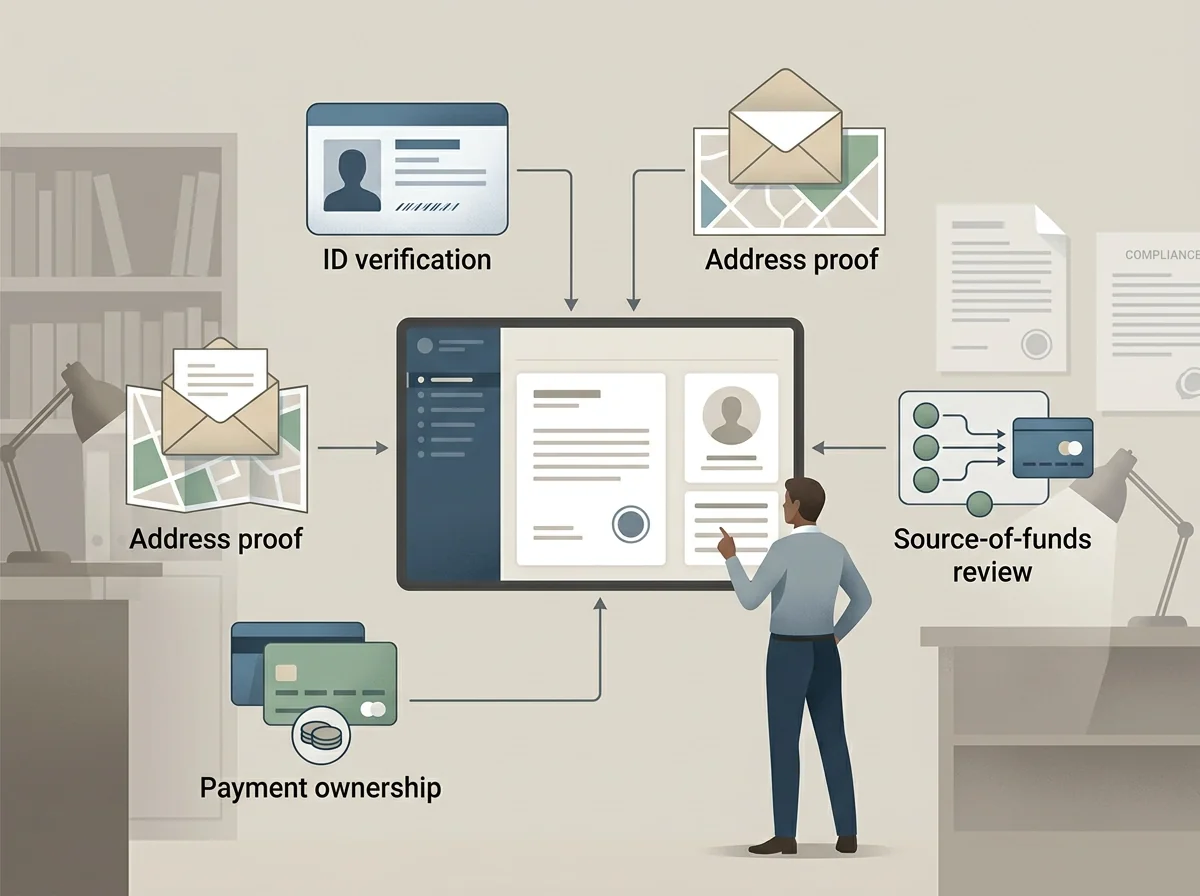
Table of Contents
- Quick answer on LegionBet KYC
- Documents LegionBet may request
- How KYC affects payouts
- Source-of-funds checks and UK expectations
- The verification sequence in practice
- Document consistency and quality
- No-KYC and instant-payout claims are unsafe
- Before uploading documents
- UK caveats around verification
- KYC as a withdrawal-risk factor
- KYC verification FAQ
- KYC readiness plan for cautious readers
Quick answer on LegionBet KYC
LegionBet’s terms say the casino may request passport details, identification cards, proof of residence, statements confirming source of funds, payment-system documents, utility bills and, in some cases, video verification. The terms also say identity can be checked before payouts and that refunds or withdrawals may be held while identity is being checked. That makes KYC central to any withdrawal decision rather than a footnote on the account page.
For UK readers, the document list is sitewide wording rather than a verified UK-specific process. This research did not confirm a UK approval time, support turnaround, document-acceptance guarantee or successful payout after KYC. No UK Gambling Commission licence was verified for LegionBet or Fortaprime SRL during this review, so the lighter-touch financial-vulnerability checks UKGC licensees must run cannot be assumed for this operator either.
Documents LegionBet may request
The official terms describe a broad range of documents the operator may request. UK readers should plan to provide each of the following on request, in current and legible form:
- Government-issued photographic ID such as a passport or a national identity card.
- Proof of residence at the address on the account, typically a recent utility bill or bank statement.
- Source-of-funds documentation such as payslips, employer statements or bank statements showing the income behind the deposits.
- Payment-system documents that prove ownership of the card, wallet or bank account used to fund the account.
- Video verification in some cases, including a short live identity check or a recorded sequence with a document held against the face.
The list is what the terms allow the operator to ask for. It is not a list of what every account will be asked for. Some UK readers may pass with only the first two items; others may face the full sequence, particularly after larger deposits, larger withdrawals or behaviour the operator’s screening flags as unusual.
How KYC affects payouts
The connection between KYC and withdrawals is direct. LegionBet’s terms say identity checks may be performed before payouts and that refunds or withdrawals can be held while a check is in progress. That means a successful withdrawal request is not the same as a completed withdrawal until verification has cleared. The official terms also list a 20 EUR/GBP minimum withdrawal and tiered EUR/GBP weekly and monthly limits, and they state that successful payment processing is not guaranteed even for supported countries. The withdrawal-specific picture is on the withdrawals page.
The practical implication for UK readers is sequencing. Verification belongs before the first withdrawal, not after it. Submitting documents in response to a payout-hold request is slower than submitting them earlier, because the operator’s response queue, the document-review step and any source-of-funds follow-up add time on top of the normal payment-rail time.
Source-of-funds checks and UK expectations
Source-of-funds checks are common in regulated gambling at larger balances and are typically the most demanding part of verification. The operator’s terms allow statements confirming source of funds; in practice, UK readers should expect requests for payslips, bank statements, savings or investment statements, or other documents that explain how the deposited money was earned. The check is about the income side, not the spending side, and it usually applies once cumulative deposits or balances cross an internal threshold.
For UKGC licensees, light-touch financial-vulnerability checks are required once a defined net-deposit threshold is crossed. LegionBet’s licence status was not verified during this review, so its internal threshold and approach are an operator-specific question rather than a UKGC framework. UK readers should be ready to evidence source of funds at whatever level the operator asks, and should not treat the operator as bound by the UKGC light-touch model unless that model is confirmed.
The verification sequence in practice
Verification typically runs as a sequence rather than a single submission. The first step is identity and address: a photo ID plus a proof of residence usually covers it. The second step is payment ownership: the operator asks for evidence that the card, wallet or bank account used to deposit belongs to the registered account holder. The third step, where applicable, is source-of-funds documentation. Video verification can sit anywhere in the sequence if the operator’s risk team flags it as needed.
Each step can pass independently. Address proof can clear while source-of-funds is still under review; payment ownership can clear before a video check is scheduled. UK readers should plan for partial progress and ask support for a clear statement of what remains outstanding rather than assuming a long silence means rejection.
Document consistency and quality
The simplest reason for a verification failure is inconsistency between documents. The name on the ID should match the name on the account, the address on the utility bill should match the address on the registration, and the card or bank details should match the deposit history. Small mismatches (a middle name on one document and not on another, an old address on a bill, a maiden name on a bank statement) can stall verification until the operator receives a clean version.
Document quality also matters. Photos of documents should show all four corners, be in focus, and not crop fields the operator may need to read. Bank statements should be downloaded as PDFs from the bank rather than photographed, where possible, so the issuing bank’s metadata is visible. Source-of-funds documents should be recent (typically within the last three months) and should cover the period of the deposits being reviewed.
No-KYC and instant-payout claims are unsafe
Some third-party reviews promote LegionBet or similar offshore brands as “no-KYC” or “instant-payout” alternatives to UKGC-licensed casinos. Those claims are unsafe for two reasons. First, they are wrong on the operator’s own published terms: LegionBet’s terms explicitly allow document requests and identity checks before payouts. Second, they push UK readers toward decisions that ignore the verification reality and the regulatory caveat.
The cautious editorial framing is to treat “no-KYC” and “instant-payout” as forbidden claims for this brand. The visible terms describe KYC as a control point the operator may use. A UK reader who chooses LegionBet on a no-KYC understanding has not understood the published terms and may face the verification process at the worst time, after a deposit and a winning balance.
Before uploading documents
- Confirm the registered account name matches the name on the ID exactly.
- Make sure the address on the proof-of-residence document matches the registered address (and that the document is recent).
- Use bank-issued PDFs for statements rather than photographs of paper statements.
- Crop document images so all four edges are visible and no required field is cut off.
- Save copies of every document submitted so the same version can be supplied again if asked.
- If a video verification is requested, make sure the camera, lighting and audio meet the operator’s stated requirements before starting.
UK caveats around verification
Two UK-side caveats apply across the KYC process. First, no UKGC licence was verified for LegionBet, so the lighter-touch financial-vulnerability checks UKGC licensees must run at defined thresholds cannot be assumed at this operator. Second, no UK-specific approval time, support turnaround or document-acceptance guarantee was verified. UK readers should not import UKGC-licensee expectations into an offshore brand’s verification process.
For UK responsible-gambling controls, the safety page covers the GAMSTOP context. Verification is part of the trust chain, but it is not a substitute for the broader regulatory caveats that apply to LegionBet from a UK perspective. The two issues should be read together, not in isolation.
Learn how regulatory verification keeps players safe on the homepage.
Completing identity checks is the most important step in improving the processing speed of withdrawals.
KYC as a withdrawal-risk factor
KYC is a withdrawal-risk factor more than a sign-up hurdle. A UK reader who plans only for sign-up and not for verification ends up with a higher risk of stalled or held payouts. The official terms make it clear that identity, address, payment ownership and source-of-funds checks are within the operator’s rights, and that withdrawals or refunds can be held while a check is in progress. Treating that wording as a small-print clause has practical consequences when a payout request is queued.
KYC verification FAQ
Is LegionBet a no-KYC casino?
No. The official terms allow the operator to request ID, proof of residence, source of funds, payment documents and video verification, and to check identity before payouts. “No-KYC” is not an accurate description of this brand.
When does verification usually happen?
It can happen at registration, before a first withdrawal, or after activity flags an internal review. The operator’s terms allow checks before payouts. Plan for KYC before the first withdrawal request rather than after.
What is a source-of-funds check?
It is a request for documents that explain how the money used to deposit was earned. Typical examples include payslips, employer statements and bank statements covering the deposit period.
Can a withdrawal be held during KYC?
Yes. The terms say withdrawals or refunds may be held while identity is being checked. Submitting documents earlier reduces the chance of a payout sitting on a verification queue.
KYC readiness plan for cautious readers
The cautious plan is to treat verification as part of the deposit decision, not an afterthought. Have the ID, the proof of residence and at least one source-of-funds document ready before the first deposit. Use a payment method in your own name. Save copies of every document submitted. Track which step has cleared and which is still open so a delay can be raised with support quickly, with reference to the specific outstanding item rather than a general complaint. For the wider account context, see the account setup page; for the payment-side picture, see the payments page; for withdrawals, see the withdrawals page.
Prepared by the Legionbet editorial staff.